
A Review of Rob Macaisa Colgate's Hardly Creatures

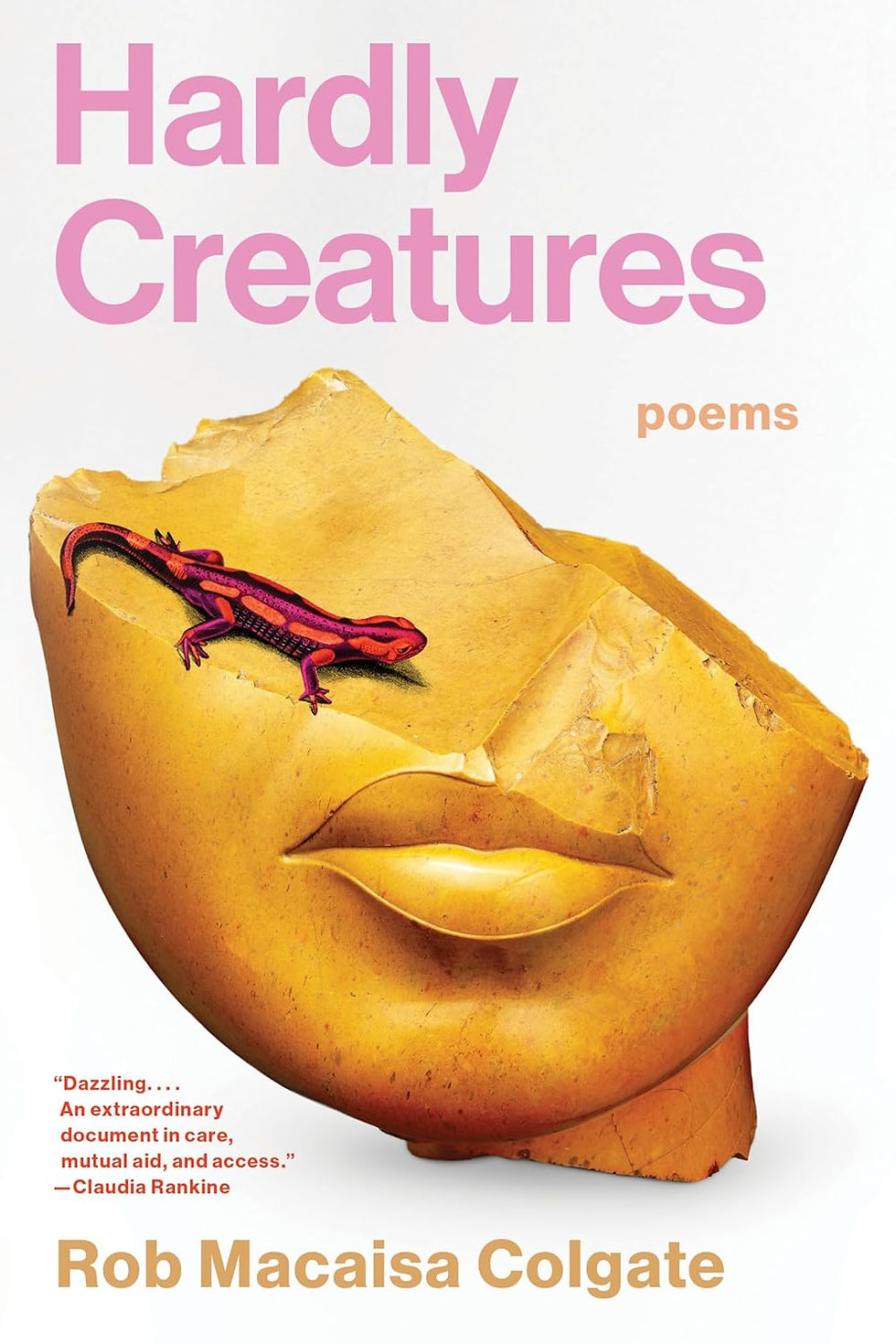
The experience of reading Rob Macaisa Colgate’s debut poetry collection Hardly Creatures is like moving through an art gallery—there are rooms, placards, accessibility guides, sensory rooms, and benches to pause and reflect upon the art. The white pages of this collection become the walls of the gallery and Colgate hangs his poems upon them, inviting the reader to experience the work from multiple angles by inhabiting a physical perspective, providing a stark reminder that engaging with art is an embodied experience that is not always made accessible for everyone.
The first part of Hardly Creatures, “Entryway,” houses only one poem, “We Do Not Enter the Gallery,” which muses on the various ways art galleries exclude disabled patrons by failing to provide access like a comprehensive ASL tour or hanging paintings too high to be viewed comfortably from a sitting position. Colgate writes, “Leaving early, I do not begin to wonder what it might look like / if my friends and I built a gallery of our own. I do not begin to wonder what it would feel like to belong,” highlighting how inaccessible spaces don’t just exclude disabled patrons from accessing art, but also reflect greater social attitudes of exclusion and marginalization.
So Colgate does build this collection as a gallery of his own, one that plays with poetic forms and shapes, symbols, time, and language of access to explore identity, disability, queerness, caregiving, friendship, and love. The collection begins with an Access Legend, modeled after social cues by Salima Punjani, small graphics that pictorially indicate information or tones of the poems similar to how they might appear alongside art in a gallery. These symbols that represent information and instructions like “Access Support Worker,” “Please Touch,” “Translation Available,” and “Relaxed Event,” take on a variety of meanings and invocations as Colgate uses them on every poem, sometimes redesigning, reorientating, or revising the graphic to reflect a deeper meaning in the poem. For example, in “Self-Portrait Without a Sense of Self,” when the head of the person in the “Physically Accessible” graphic takes on the point of a question mark, highlighting the speaker’s disorientation of self.
Community and collaboration are at the heart of this collection and become a mode of creating the poems, as Colgate writes about his relationship with his friends and partner as a collaboration in communicating and caring for one another. “The Softness of Language” is a series of erasure poems titled, Rob, Lorraine, and Rob & Lorraine, each poem building upon one another in a series of collaborative black out and erasure poems, painting a portrait of a relationship between two friends not just as individual people with separate language and experiences, but one interwoven story. The final, short collaborative section reading, “wash our language fresh / each I more than I — a team.”
The language of these poems are accessible, playful, and humorous even as Colgate explores more difficult topics like suicidality, police brutality, and Canada’s Medical Assistance in Dying law. In one poem, “History of Display,” he chronicles a history of disability visibility placing the invention and use of lobotomy and force sterilization beside, “Mad people exist in public / (Guys this one doesn’t go well)” and “Lana Del Ray releases Born to Die / causing thousands of adolescents / to develop clinical depression,” inhabiting a wry tone that catches the reader off guard and lightens the reading experience.
In the title poem, “Hardly Creatures,” Colgate moves through a digital tour of a science museum with a friend, listening as a tour guide marvels at the resilience of animal and human creatures throughout time. When his friend says she feels uncomfortable with humans being referred to as creatures, Colgate muses, “Every creature forever feeding / whatever mouth is in front of them / either born knowing how to love / or picking it up down the line.” Here Colgate situates care giving and receiving not just as a human act, but something larger than us and inherent to the experience of being a living creature. This idea reverberates throughout the pages of this collection, reminding the reader that taking care and being cared for is not just what makes us humans, but a fundamental part of being alive.

Mialise Carney is a writer whose stories and essays have appeared in swamp pink, Booth, Washington Square Review, and other places. She is a PhD student in creative writing and literature at the University of Cincinnati, where she reads for The Cincinnati Review and teaches writing.